02
IONIK LABS / INSTRUMENT ONE
IONIK
Six oscillators. Thirty-six ways to point them at each other.
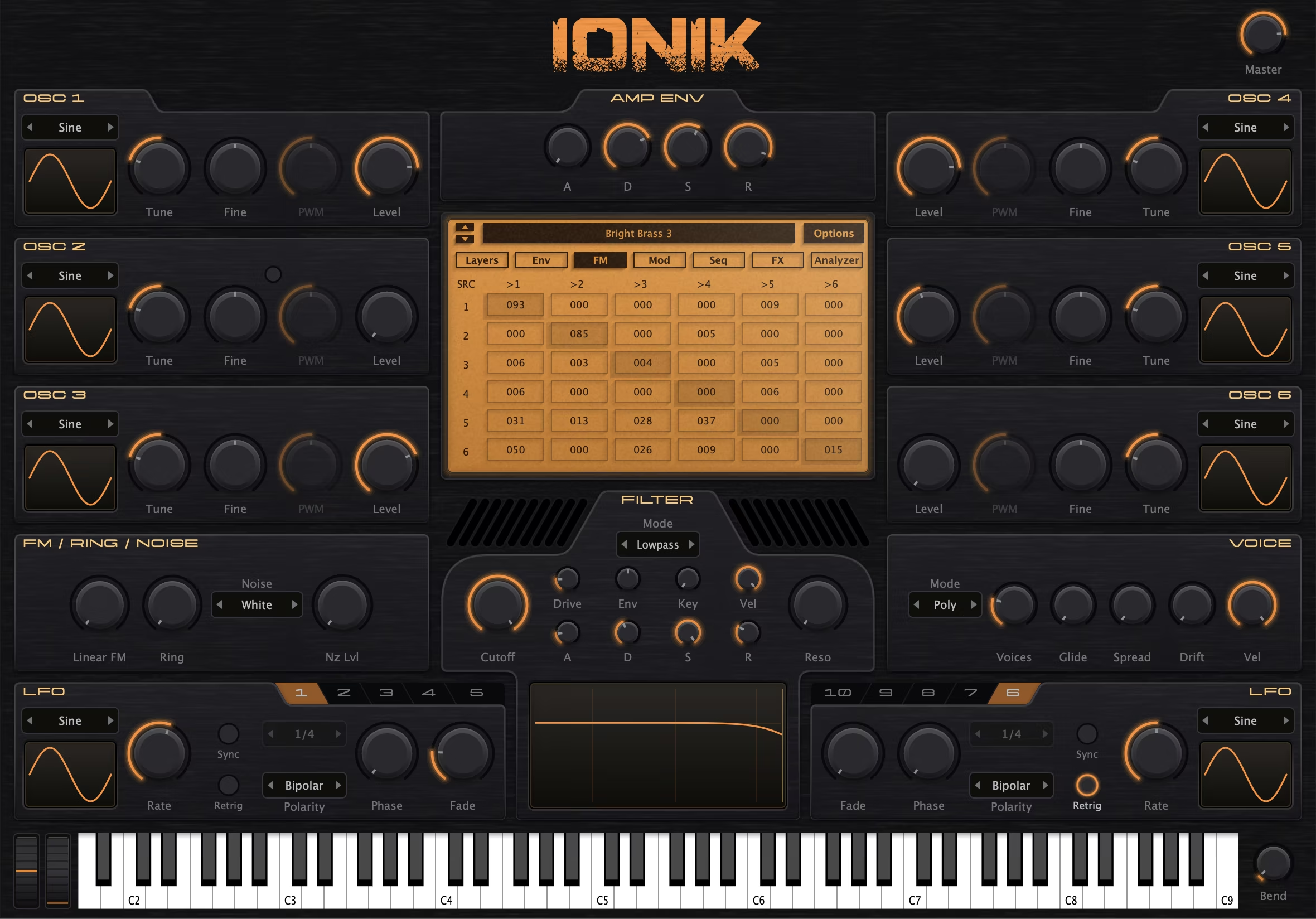
Six oscillators, each one both a classic subtractive oscillator and an FM operator, wired into a full 6×6 phase-modulation matrix. Stack four of these instruments on one keyboard and run them through a single rack of ten effects you can reorder.
JOIN THE WAITLIST
You are on the list. Check your email — it has your place in the queue and what happens on release day.
That did not go through. Try again in a moment.
INSIDE
- 1 / 7
SIX OSCILLATORS
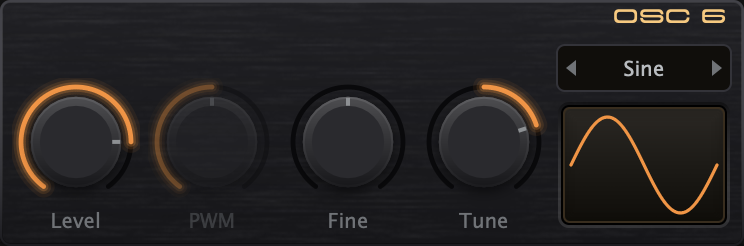
Subtractive and FM at the same time, per voice.
Six oscillators give you plenty of room to build sounds with real depth and character. Layer different tones, spread them across octaves, detune them for width, or combine them into something completely new.
From simple patches to massive layered sounds, you have plenty to work with before even reaching for effects.
- 2 / 7
TEN LFOS
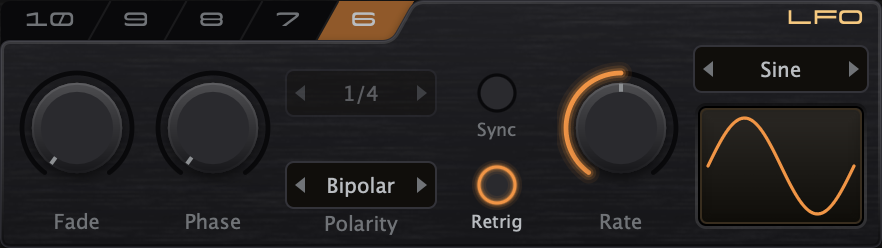
Ten of them, per voice, each one a full modulator.
Ten LFOs per voice, every one with the same controls: seven shapes, free-run in Hz or locked to the host across 20 tempo divisions, a start phase, a fade-in, retrigger, and a choice of bipolar or unipolar.
The panel shows two at a time and the numbered strip picks which. Everything else stays where it is, so moving between them is a click rather than a change of view.
They reach the sound through the modulation matrix, alongside the envelopes and the performance controls — including each other’s rate, so one can drive another.
- 3 / 7
FOUR LAYERS
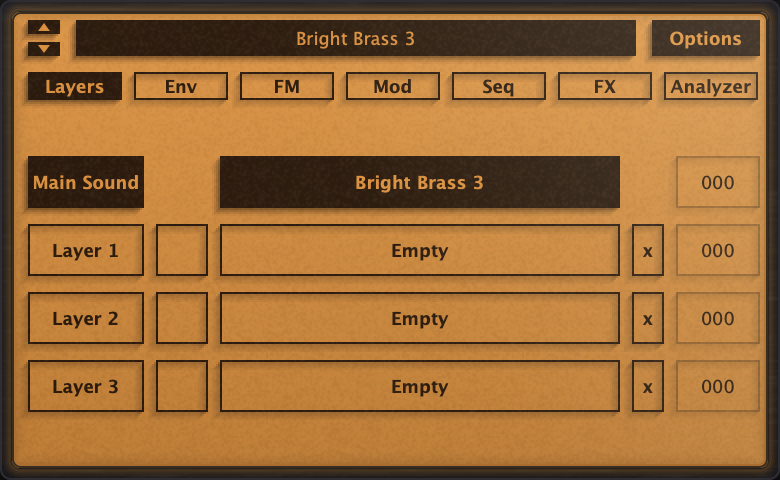
Four complete sounds, one keyboard, one rack.
Combine up to 4 presets to create bigger, richer, and more complex sounds. Each layer works as a complete, independent patch, with its own oscillators, filter, envelopes, LFOs, modulation, and sequencer.
Blend complementary sounds, stack different textures, or build entirely new patches by adjusting each layer individually. Control the balance between layers to create anything from subtle enhancements to massive, evolving sounds.
Saving a Stack Preset captures all four layers and their settings together, allowing the entire layered sound to be recalled instantly as a single custom preset.
- 4 / 7
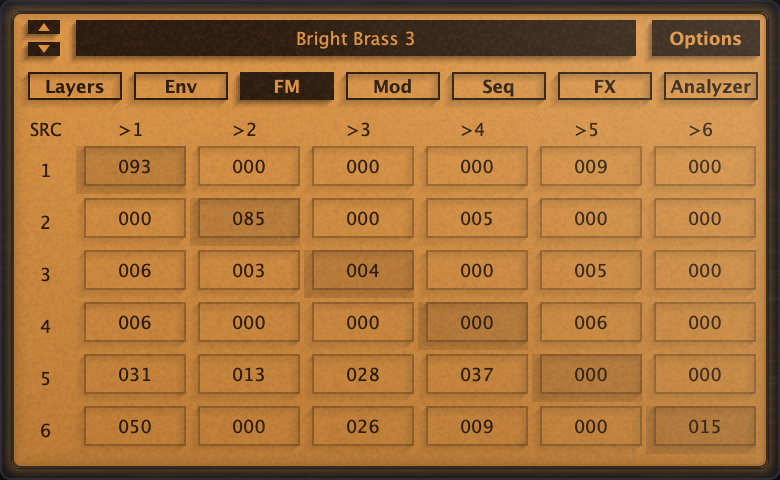
FM MATRIX
Six by six. Thirty-six depths, and no algorithm number.
A classic six-operator FM synth makes you pick an algorithm: a numbered wiring diagram that fixes which oscillator modulates which.
Each cell sets how hard one oscillator modulates another. The cells running corner to corner are the exception: there, an oscillator modulates itself. That self-feedback is what gives an FM sound its hard, biting edge.
The grid shown here is the plug-in’s own control, captured from the window. A playable version — the same routing running live in your browser — is still being built.
- 5 / 7
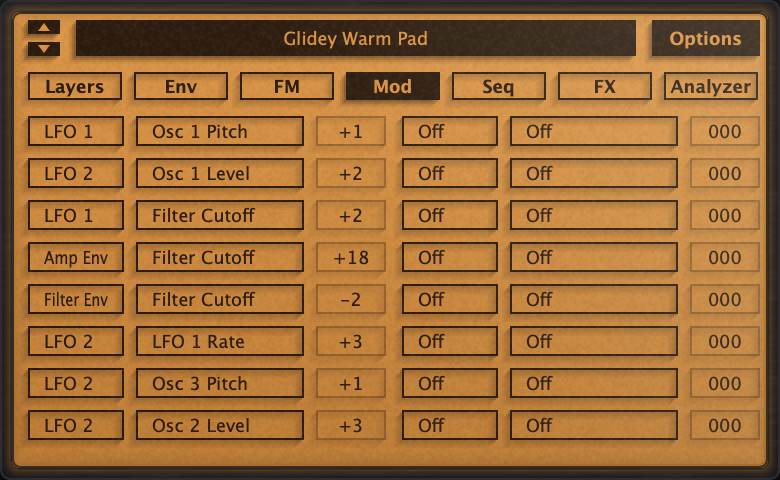
MODULATION MATRIX
Sixteen slots, and separate from the FM matrix above.
Take your sound beyond the basics. The Modulation Matrix gives you sixteen slots with the freedom to connect modulation sources to different parts of the synth, opening up everything from subtle movement to evolving textures and expressive, constantly changing patches.
Build simple connections or push things further with multiple modulation routes working together.
- 6 / 7
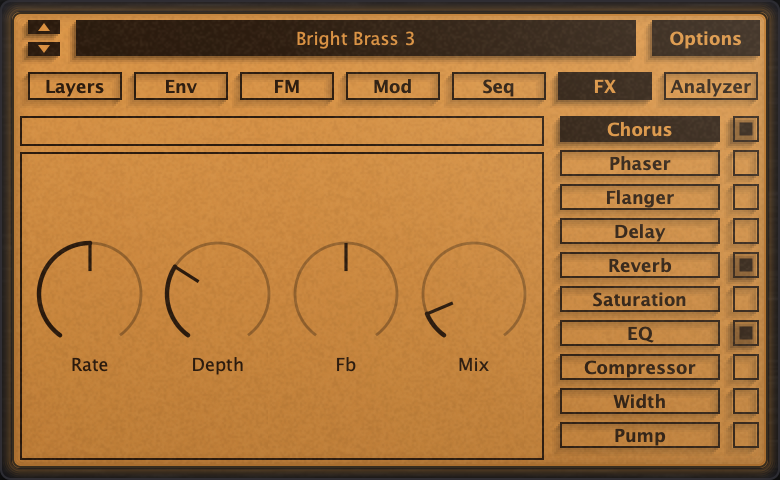
THE RACK
Ten effects, in whatever order you drag them into.
Chorus, phaser, flanger, delay, reverb, saturation, three-band EQ, compressor, stereo widener and Pump, all shared by the four layers.
You set the order by dragging, and that order is deliberately not an automatable parameter. Each effect has its own bypass.
- 7 / 7
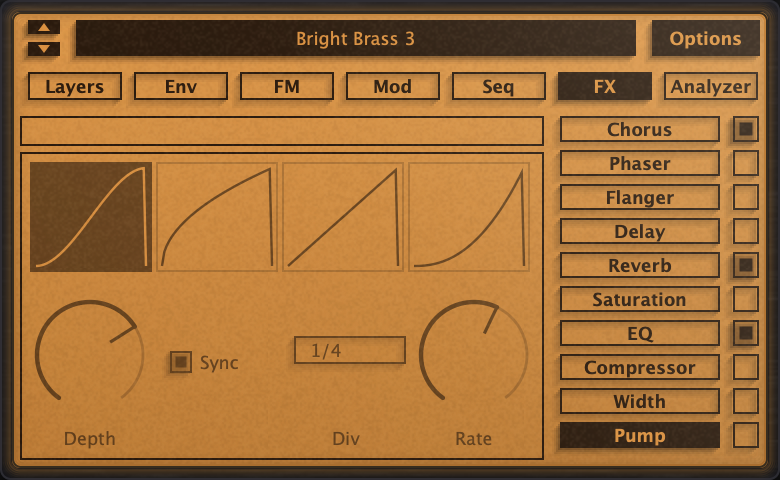
PUMP
A ducker that stays locked to the bar.
Get that signature pumping feel without setting up a sidechain. Lock it to the tempo, choose from four pump shapes, and dial in anything from a subtle groove to a hard rhythmic duck.
Fast to set up, easy to shape, and always ready when the track needs more movement.


READ FROM THE SOURCE
SPEC
| Component | Specification |
|---|---|
| Oscillators | 6 per voice · saw, square, triangle, sine · PolyBLEP bandlimited · ±24 st, ±100 ct, PWM |
| FM matrix | 6×6 = 36 depths · the diagonal is feedback · PM lands on sine destinations |
| Cross-oscillator | hard sync (A→B) · ring modulation (A×B) · dedicated FM amount (A→B) |
| Noise | white / pink, with its own level envelope |
| Filter | ZDF state-variable · lowpass, highpass, bandpass, notch · 20 Hz – 20 kHz · resonance, drive, key tracking, velocity · ±6 octave envelope |
| Envelopes | 9 ADSRs per voice — amp, filter, one per oscillator, one for noise |
| LFOs | 10 · seven shapes · free-run Hz or 20 tempo divisions · phase, fade-in, retrigger, bi/unipolar |
| Mod matrix | 16 slots · 19 sources × 38 destinations |
| Sequencer | 64 steps per layer · semitone offsets, rests, swing, dual lane, ping-pong, random |
| Layers | 4 complete patches · one keyboard · one shared rack |
| Effects | 10, reorderable, per-effect bypass |
| Voices | up to 64 (default 16) · poly / mono / legato · glide · drift · stereo spread |
| Parameters | 320 exposed to the host, every one automatable |
| Presets | 118 factory across 10 categories |
| Format | VST3 and AU · Windows · macOS · universal Apple silicon and Intel · window 1180×824, fixed |
| MIDI | pitch bend (range 0–48 st), mod wheel, aftertouch, CC74, sustain |
QUERIES
What are the system requirements?
A 64-bit Windows or macOS computer, a DAW that loads VST3 plug-ins — or Audio Units, on macOS — and a screen big enough for a 1180×824 window. The window is a fixed size and cannot be resized, so that last point is a genuine requirement, not fine print.
The macOS build lists 10.13 as its minimum and ships as a universal binary, though the Apple-silicon version needs 11.0 or later whatever the minimum says.
On CPU we can now give you a number instead of an adjective. All four layers sounding, sixteen voices in each, with the whole effects rack switched on, costs 12% of one core at 48 kHz through a 64-sample buffer on an M1 MacBook Pro — a single layer of sixteen voices is 4.7%, and an idle instrument is under two tenths of one percent. That is the engine measured directly, so it excludes your host's own overhead and the interface. Your figure will differ with your computer, which is exactly why the computer, the sample rate, the buffer size and the voice count are quoted next to it: a percentage without them is marketing, not a measurement.
We have still not published a Windows minimum or an install size, and we will not until we have established them the same way. A version number taken from the SDK a thing was compiled against is not the version it runs on.
Which platforms does it run on?
Windows and macOS. On Windows you get the VST3. On macOS you get both the VST3 and the Audio Unit, from a universal binary that runs natively on Apple silicon and on Intel — the Audio Unit is a macOS format and has no Windows equivalent, which is the only difference between the two builds.
The preset format and the saved plug-in state are plain data and are not tied to the machine that wrote them, so a session moves between machines freely, including across the two platforms. Anything not in the spec table above is not in version 1, and we are not promising a date for it.
What DAW is it compatible with?
Any DAW that hosts VST3 plug-ins, on either platform — and on macOS, any that hosts Audio Units, which is what makes Logic Pro a supported host. It comes down to whether your DAW loads one of the formats you have: the macOS installer places both, the Windows one places the VST3. If it does, IONIK turns up in the instrument list like any other plug-in; if it does not, it will not appear at all. The spec table above is the whole story — no asterisks.
There is also a Standalone build in the source, but it is only a test harness for development and is not distributed. Do not count on running IONIK outside a DAW.
How many computers can I have it installed on?
Install it on as many of your own computers as you like — the studio desktop, the laptop, the machine in the other room. Installs are not counted or limited.
Two of them can run it at the same time. If you need a third while you are away from one of the others, just deactivate the one you are not using. There is no time limit, and nothing is one-way.
IONIK LABS
Familiar when you want speed. Built to go further when you want depth.
IONIK combines the immediacy of subtractive synthesis with the depth of six-operator FM. Start with oscillators, envelopes and a filter, then route any of the six oscillators through the 6×6 FM matrix — without being restricted to fixed algorithms.
When one sound is not enough, stack four complete patches on a single keyboard. Shape each layer independently, give it its own 64-step sequence, then run the combined sound through one reorderable rack of ten effects. Save the entire construction and recall it as one preset.
The result is one instrument that can move from focused basses and keys to evolving pads, metallic textures and rhythmic sounds — without assembling the patch across multiple plug-ins.
118 factory presets give you somewhere to start. The matrix gives you somewhere new to go.
- Company
- IONIK Labs